

V2X, Ready to Build On
Hardware integration is only the starting point, not the differentiator. The cube:evk goes beyond hardware with a complete, open V2X platform designed for flexibility at every layer. The full stack is documented and configurable, including APIs, ROS 2 integration, and simulation environments, all supported by public examples and sample code to accelerate development. The platform can be adapted, extended, and customized to fit a wide range of applications and deployment needs.
For readers new to V2X: Vehicle-to-Everything (V2X) communication enables vehicles, infrastructure, and vulnerable road users to exchange information in real time. This supports applications in road safety, traffic efficiency, and connected mobility.
One Device, Many Roles
The cube:evk integrates multi-radio communication, embedded compute, connectivity, and positioning in a single device.
It supports DSRC/ITS-G5, C-V2X/LTE-V2X, and network-based communication, enabling interoperability across different deployment scenarios. GNSS with dead reckoning keeps positioning accurate even where satellite signals drop out.
At its core, a quad-core processor and an integrated neural processing unit (NPU) handle real-time processing at the edge. Interfaces span CAN, Ethernet, USB, HDMI, Wi-Fi, Bluetooth, and LTE, connecting to vehicles, roadside infrastructure, and cloud systems.
The integrated NPU accelerates AI inference directly at the edge, supporting AI-driven perception functions such as road user detection. These capabilities enhance the device's contribution to collective perception by extending the range and richness of detected environmental information.
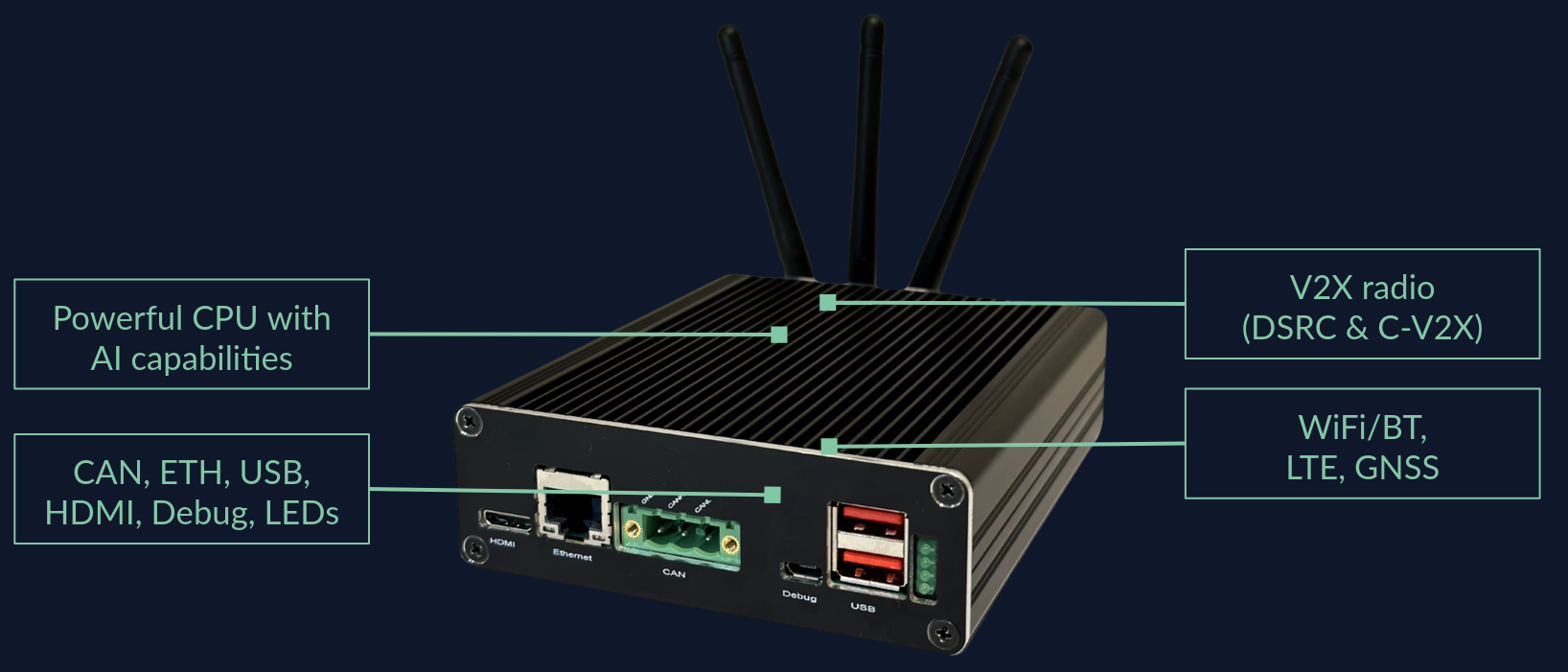
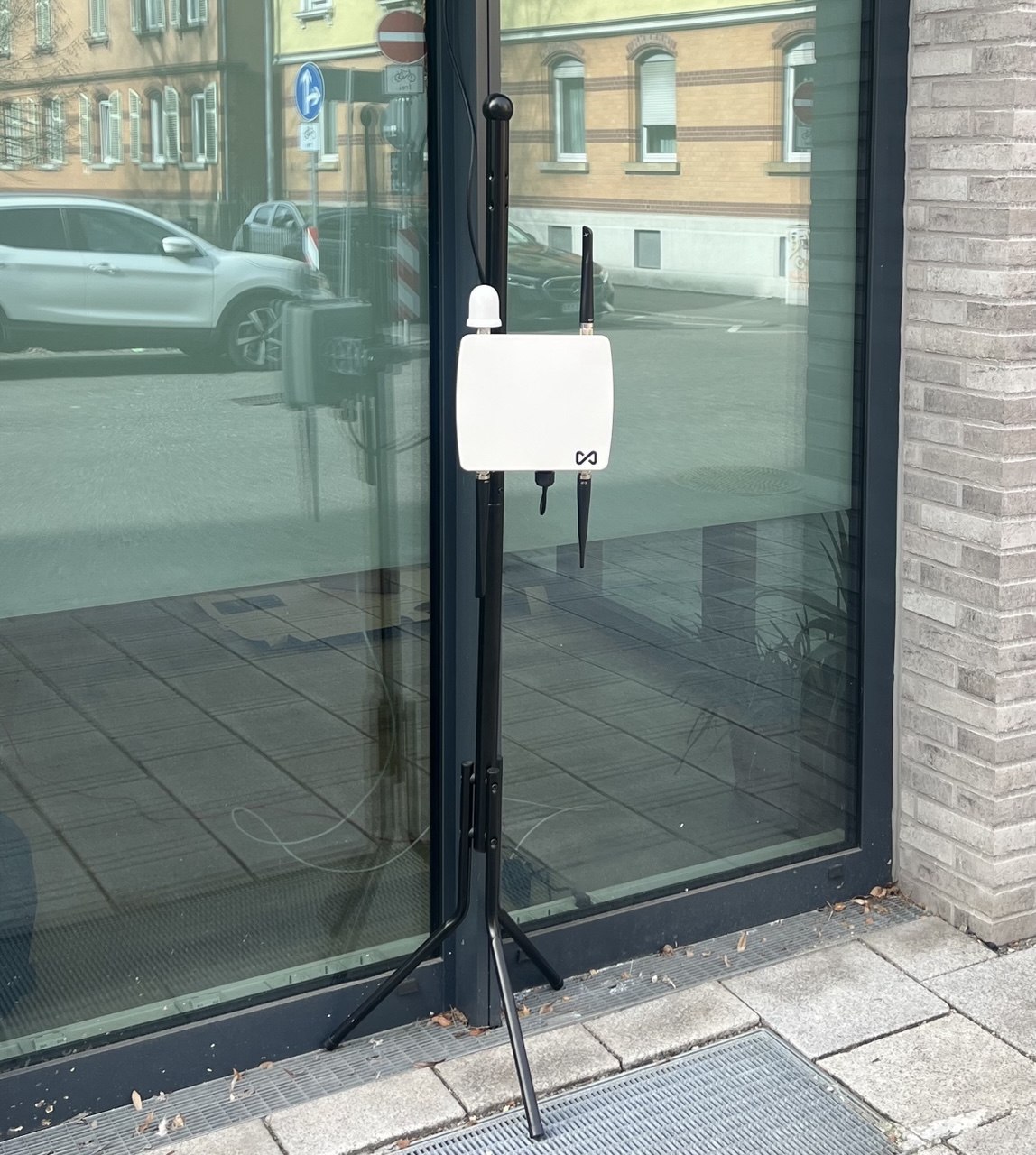
The same unit can operate as an On-Board Unit (OBU), a Roadside Unit (RSU), a connectivity gateway, or a radio-only node, and can be customized for specific V2X products. Since all components are built on a common platform, integration is already inherent: the hardware used in development and testing is the same as the hardware deployed in the field.
Software Stack
The platform runs on cube:os, a Linux distribution based on Yocto. On top of it, two V2X stacks ship by default: Vanetza, a full ETSI C-ITS protocol stack (GeoNetworking, BTP, DCC, Security), and cube:its, a containerized ROS 2 ITS framework including facilities for CAM (Cooperative Awareness Message), DENM (Decentralized Environmental Notification Message), CPM (Collective Perception Message), VAM (Vulnerable Road User Awareness Message), I/O, kinematics, path prediction, and more.
Native Artery support adds software-in-the-loop testing, and SUMO + cube:hive instantiate ITS capabilities per simulated vehicle. These enable development and specification of C-ITS applications in simulation, which can be switched directly to field tests.
For remote execution and testing, the software stack can run on a host system, with the cube:evk operating as a remote V2X radio-only device.
Both the hardware and software stack are developed in-house, with all components designed to operate within the same ecosystem. This unified approach keeps the platform coherent while enabling long-term maintenance, integration, and continuous improvement. The system remains fully open to third-party software, custom applications, and alternative V2X stacks running alongside the provided components.
Built on ROS 2
Because cube:its is built on ROS 2, it integrates with the wider ROS 2 ecosystem: sensor drivers for Lidar, radar, and cameras run alongside it, and ROS-based autonomous-driving stacks such as Autoware can be combined with it. V2X data is exposed as standard ROS 2 messages and flows through the same ROS 2 graph as the rest of the ROS 2 nodes. Since ROS 2 supports multi-host operation, custom nodes and pipelines running alongside can be distributed across multiple hosts within a shared domain.
Open by Design
Every layer of the cube:evk is open, with visibility and control from the hardware up through the application layer. The documentation is public, providing a starting point that already runs.
Low-level APIs such as PoTi and direct radio control unlock fine-grained access across the stack, with configuration exposed throughout the system. This openness turns the platform into a building block: instead of adapting to fixed constraints, the system is shaped around the application.
Applications
The cube:evk supports V2X applications across several domains.
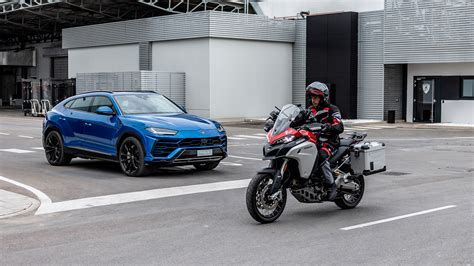
- Safety Applications: Cooperative awareness and hazard messaging improve road safety and enable protection of vulnerable road users.
- Advanced Perception: Collective perception extends awareness, enabling vehicles and infrastructure to share detected objects in real time.
- Smart Infrastructure: Intelligent roadside systems with support for traffic-light and map-based communication capabilities.
- Priority and Emergency Services: Emergency vehicle warnings and approach signaling, public transport prioritization, and related traffic-management scenarios.
- Autonomous Vehicles and Robotics: ROS-based perception and planning combined with edge AI and V2X data for cooperative, connected operation.
- Connectivity and IoT Gateway: Data from vehicles, sensors, and roadside equipment is collected at the edge and forwarded to backend systems over Ethernet, Wi-Fi, or LTE.
- Micromobility and VRU Ecosystems: Bicycles, scooters, and other VRUs integrated into the connected environment, enabling safer and more predictable urban mobility.
Summary
Put simply, the cube:evk combines the following in one platform:
- Openness: Full access from low-level hardware to application layer, backed by public documentation, examples, and sample code
- Completeness: Hardware, software, and ecosystem in one integrated platform
- Flexibility: Suitable for automotive, infrastructure, and micromobility applications
- Freedom to innovate: Not bound to a fixed specification: adapt, modify, and experiment, from research and prototyping to product-specific integration
- Developer Experience: ROS 2, Python and C++, remote radio mode, open simulation integration (Artery and SUMO with cube:hive available, more environments such as CARLA and Autoware can be integrated)
- Cost-Effectiveness: Software stack without licensing fees, hardware and software delivered from one source, and free OTA updates keeping every component, firmware included, current over the air
The result is a platform that delivers V2X capability from the start and supports the project as it grows, from exploration through prototyping to production. Whether that makes it the right fit depends on the specific project requirements.
And if something is missing, just reach out: we're open to ideas and collaboration.